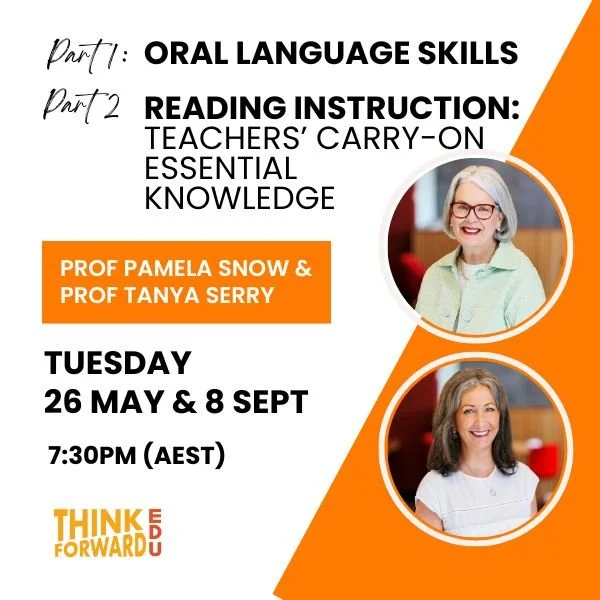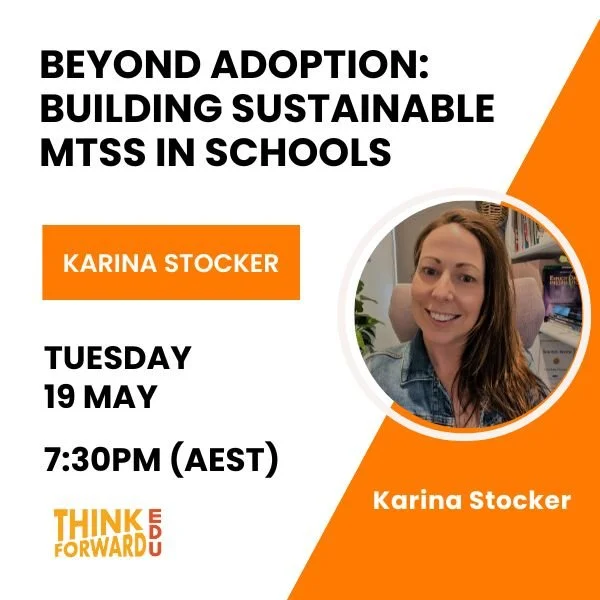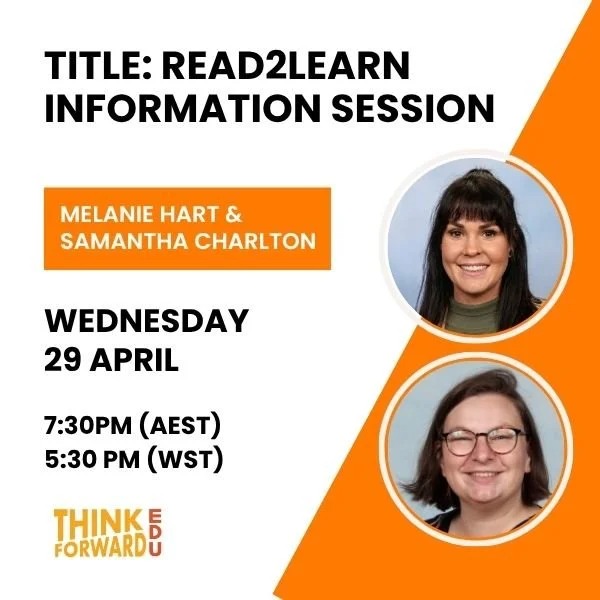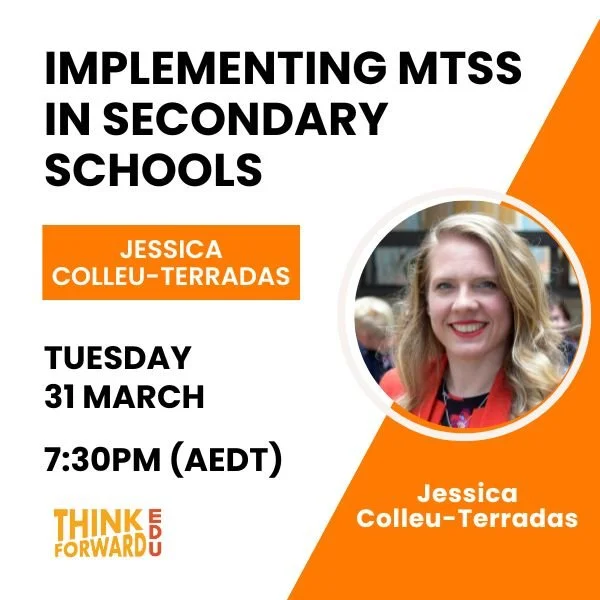
Upcoming events and free Webinars.
Our events are open to all!
Missed an event?
Previous Webinars available here!
Catch up with recordings, slides and other resources in the Members’ Area.
A free login to TFE is required.

Lyn Stone - Spelling Choice Hell - Gippsland Branch
Presenting Spelling Choice Hell. Lyn Stone is a very special guest at Gippsland Branch of Think Forward Educators.

Dr Russ Fox - Practical ways to collect and use student behavioural data
Teachers are required to record data on disruptive or challenging student behaviour within the classroom or yard. This often ends up looking like a long-form narrative record of “what happened” – either posted into the student management system or in a Google Doc. These records can be time-consuming to write and can provide limited impact when trying to understand and plan for a student’s behaviour. This session will be a practically focused webinar aimed at providing teachers with the knowledge and tools to engage in behavioural data collection that matches the needs of their students and context in the most practical ways possible.

How do we make the most of examples, explanations, and elaborations?
Cognitive science tells us that, especially with novices, the use of worked examples, direct instruction, and self-explanation and elaboration are key. So, what can we do to make the most of each of these? What are the differences between effective and ineffective uses of examples? How do we make our explanations more impactful? What elaborative questions should we be asking students and have them ask themselves to get more out of a given question?

Marshall Roberts - Putting the tract in tractor: Dragging literacy out of the dark ages - Tas Branch
Marshall Roberts talks about his family’s journey into home tutoring and literacy advocacy. Marshall will discuss his family’s background story, what fired him up, what he’s learnt along the way, some parallels between education and farming cultures (yes, really!) and what he’d do differently in hindsight. He will also share some reflections and information for other parents who may be just at the point of thinking “something’s not right”.

Dr Daniel Ansari - Building blocks of mathematical competence: evidence from brain and behaviour
Recent research has shown that basic number processing (such as comparing which of two numbers is larger) is related to individual differences in children’s arithmetic achievement. Furthermore, children with mathematical disabilities (Developmental Dyscalculia) have been found to perform poorly on basic number processing tasks. In this talk I will review evidence for an association between basic number processing and arithmetic achievement in children with and without mathematical difficulties. I will draw on evidence from both brain and behavior and discuss the implications of this research for assessment, diagnosis and intervention.

SA Branch - Tier 2 Intervention for Secondary Students
This session will share the innovative practice of two speech pathologists and the literacy leadership teams they work with at Craigmore High School and Parafield Gardens High School.
Grounded in the science of reading, a wave 2 evidence-informed reading intervention program for year 7 and 8 students who have word reading (decoding) ages between 6 to 10 years will be outlined. Participants will gain an understanding of the assessment process, the intervention, and positive outcomes achieved across the two schools.
This presentation is relevant to primary and high school teachers and leaders who have an interest in improving student reading ability, or who are curious about what Speech Pathology can offer in a high school setting or adolescent reading intervention space.

Toni Hatten-Roberts - Science of Maths and the Importance of Fluency
How many times do you hear - 'but they don’t know their facts!' Being able to recall multiplication number facts might just be one of the single most important skills that all students need to have mastered by Year 4 to succeed in any future mathematics. Math fact fluency is the ability to quickly and accurately recall the answer to basic math facts. Research on cognitive load supports the idea that we can reduce the load for our students through the fluent recall of facts. However, educators cannot rely anymore on ‘the back of the toilet door’ strategies; nor repeat the ‘rote’ procedures of the past. In this session we explore the ‘why’, ‘what’ and ‘how’ in supporting student maths fluency of facts and more!

GELL Nov Meeting - Monitoring Early Reading Progress
Gippsland Branch of Think Forward Educators are hosting an evening session on Monitoring Early Reading Progress. Join us for discussion and sharing of best practice.

James Dobson - Laying Mathematical Foundations - Maths Network
The Science of Learning is revolutionising Reading instruction. In contrast, the impact of the Science of Learning has been limited in a Maths space dominated by mindsets, productive struggle and rich tasks. In this session James will take us through the structure of a typical Maths lesson in his class. He will demonstrate how using a Revise-Learn-Apply framework supports student learning. James will unpack how employing a Science of Learning approach, coupled with high expectations, allows teachers to build a strong foundation for their students.

Science of Maths with Dr Amanda VanDerHeyden
Armstrong Creek School presents Dr Amanda VanDerHeyden, an international renowned policy adviser and thought leader who actively conducts research focused on improving learning outcomes for students. Join us as Dr VanDerHeyden discusses her expertise across the Science of Maths, as well as maths intervention within a multi tiered system of supports.
Dive into DIBELS Reading Assessment
Take a dive into the DIBELS reading assessment. DIBELS is a freely available reading assessment from the University of Oregon, for students from Foundation to Year 8. This session covers how, when and why to use DIBELS as part of literacy assessment in primary schools and into early high school. See examples of how DIBELS is used at Carlton Primary School to inform planning for classroom and intervention teaching.

David Morkunas Launching the Think Forward Maths Network
Launching our first ever meeting of the Maths Network, Join David Morkunas as he unpacks the elements that have led Bentleigh West Primary School to be recognised as a high-performing school for mathematics. This session aims to bust the myth that some students or teachers “just aren’t any good at maths” and will prove that any teacher can become comfortable teaching mathematics to a high standard. This session will demonstrate how David and his colleagues use approaches including Explicit Direct Instruction and Cognitive Load Theory in order to craft and teach lessons which give their students the greatest possible chance of success in mathematics.

From the big five to a coherent curriculum: Dr Nathaniel Swain and Shane Pearson
At Brandon Park Primary School, we are building upon our low variance spelling and word reading curriculum, to make direct connections between spelling, reading, and writing instruction within English lessons and in every learning area. In this session we will describe how we are ensuring that in every subject, children are supported to read, write and discuss high-level academic concepts and ideas, and put their hard-won literacy skills to good use. This practical and research-informed presentation will detail how we have sought to make explicit and direct connections between what students are learning in English, and the vast knowledge bases in the Arts, Sciences, and Humanities. By using a knowledge-rich, coherent and cohesive curriculum map, and the thought-enriching techniques from the Writing Revolution, we are supporting our students to become informed, insightful, critical and independent readers, writers, and learners. Come hear how you could do the same!

What it takes to shift practice - Montello Primary School's Journey towards structured literacy
As a small, regional primary school with a vulnerable student population, the leadership of Montello Primary School knew that changes were needed to support their students to become proficient readers. Over the course of a year, the school has trained staff and implemented a structured literacy approach in their early years classrooms. This hasn't come without challenges, but Dion McCall (Principal) and Ruby Moore (Quality Teaching Coach) are ready to share preliminary data, experiences and wisdom with other schools thinking of embarking on a similar journey. In this session, Jocelyn Seamer will facilitate a conversation with Dion and Ruby about their methodology, motivations and future plans for structured literacy in their school.

Shane Pearson - Introducing PhOrMeS: A Free Foundation-Year 6 Word Reading & Spelling Curriculum
Standing for Phonology, Orthography, Morphology, Etymology and Semantics, PhOrMeS aims to equip teachers and schools with a ready-to-teach, comprehensive, whole-class curriculum which covers the skills outlined above. In this webinar, you will hear from the lead author, Shane Pearson. You will learn about the components of the PhOrMeS Word Reading & Spelling Curriculum and how they progress from Foundation to Year 6, learn how PhOrMeS uses the SoR and SoL to teach decoding and spelling, and see examples of slides and instructional sequences and much much more.

Follow Up Q and A - Creating and sustaining effective learning environments using behaviour science
Join us for this follow up Q and A for this very popular session! Have you been working hard to establish classroom routines and clear behavioural expectations at the start of this year?
Dr. Russ Fox and Dr. Erin Leif are obsessed with all things behaviour and are excited to talk with Think Forward Educators about ways to create and sustain positive and productive learning environments for all students.

Beyond Phonics...Morphology & Why it Matters
Jasmine Shannon, and Kylie Conrad are morphology-obsessed. Seeing morphology as such an unsung hero. they constantly research Greek and Latin and how these languages influence the way we spell today. Morphology has huge potential to build comprehension, vocabulary and to drive spelling instruction. However, how this is used is still being thought out in many schools. Morphology is the organisational feature of the entire English spelling system which shares a leading role with phonology and is heavily influenced by etymology. Join us for this exciting presentation, and get ready to become morphology-mad too!

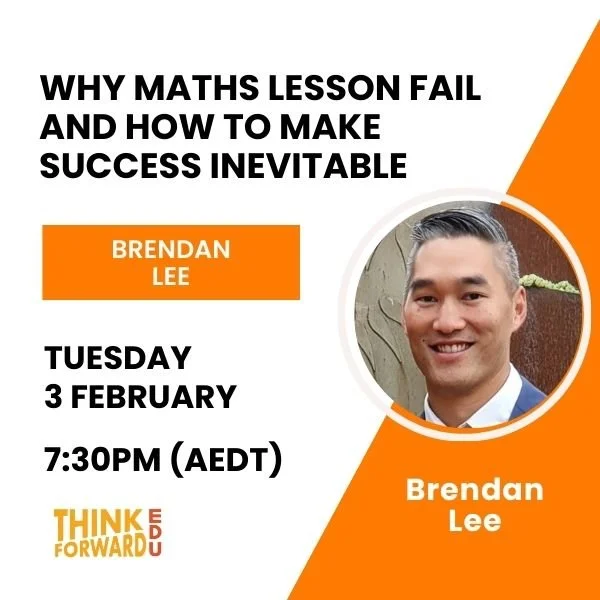
Implementing the science of learning when the rest of the school isn't - Brendan Lee
Have ever you had the realisation that the way your school has been going about things is not evidence-informed? Have you also struggled with initiating the changes that are needed for school improvement? This talk is targeted at classroom teachers and middle leaders who are experiencing barriers in the implementation process. In this presentation, Brendan will discuss some of the strategies that teachers can use when approaching school leaders and what you need to understand before moving forward.

ACT Branch - Patrick Ellis - Canberra & Goulburn Archdiocese
Join the ACT Branch of Think Forward Educators and to be part of a community that shares ideas, builds knowledge and learns together. We meet Week 4 every term, hosted by a selected school in the ACT.

A crash course in pedagogy for surviving and thriving in the English classroom
Rebecca Birch hosts a crash course for early career English teachers on how to create cultures of writing and reading in the classroom. Drawing on evidence-based practice, Rebecca will share key strategies to support teachers in making writing routine, including the direct teaching of writing structures that enhance learning, and the modelling and scaffolding of responses. She will also present on how to support students in reading comprehension, while providing an appropriate level of challenge. Finally, she will present on the structures and resources that can support early career teachers in doing their job, for example effective use of aides, strategic programming and efficient whole class and individualised feedback.

Dr Toni Seiler - GELL May 2022 Meeting -
Our first GELL of 2022 meeting was presented by the wonderful Dr Toni Seiler on 'Dyslexia - its nature prevention and intervention'.
Answering your questions about mathematics education
Do you have burning questions about mathematics education including understanding a particular concept or process or suggestions on how could to best teach them? Ask Maths Education Whiz Alex Blanksby !! What about Engelmann's Direct Instruction and Theory of Instruction including making the most of your explanations and examples, the textbook making process, or the Vic Maths Notes website? Ask them in a live Q&A session! Submit your questions in the registration form or during the session.
SA Branch Trauma informed schooling and EDI
We are excited to welcome James Kelly and Dave Pascoe for this SA Branch Event. This presentation will demonstrate the contextual and sustainable approach to Trauma Informed Practice at Elizabeth Vale Primary School. Key elements will be: the importance of intentionality, predictability, consistency and communication in a trauma informed school and some tips that we would give to others on a similar journey. From here, the workshop will provide a snapshot of Explicit Direct Instruction (EDI) as a pedagogy for learning and how it complements the trauma informed approach. It will provide a very clear idea of what EDI is and what EDI is not and some practical uses in a classroom setting.

Effective classroom setup: Docklands Primary
Basing their work on professional reading around the importance of calm, settled learning environments, our guest presenters will be sharing their experiences and findings about effective classroom setup. Reviewing the kinds of seating plans that lend themselves to different kinds of work in the classroom; they have a heap of practical experiments in their own classrooms to share!
Jac and Leah will also share insights about classroom displays and organising student materials.

Mentor Program Professional Learning - Teaching Sprints
Mentors and Mentees of the Semester 1 2022 Mentor Program came together for this welcome professional learning session of Teaching Sprints with author, Dr Simon Breakspear. Missed this session, access the recording now.
Creating and sustaining effective learning environments using behaviour science - Dr Russ Fox and Dr Erin Leif
Have you been working hard to establish classroom routines and clear behavioural expectations at the start of this year? Are you wondering how to sustain, embed, and then responsively adapt these practices over the course of the year? Diving into behaviour science may assist you with your behaviour change efforts (yours and your students!).
Dr. Russ Fox and Dr. Erin Leif are obsessed with all things behaviour and are excited to talk with Think Forward Educators about ways to create and sustain positive and productive learning environments for all students.

Dr Jenny Donovan - Off the website and into the classroom: How AERO is going to accelerate the use of evidence in education practice
The Australian Education Research Organisation (AERO) has been funded by Australia’s nine education ministers to support education to become more evidence-based, in order to improve learning outcomes for children and young people. Even when evidence is compelling, proven effective practices are not necessarily the approaches most commonly used in schools. This presentation will look at why AERO considers implementation to be the biggest challenge to evidence-based practice, and what AERO will do about it.

Benji Gersh - Greater Space
Join Benji Gersh has he addresses the assumptions that are implicit in all behaviour management strategies and relational approaches to education. There is a gap between knowing information and being able to implement it effectively. This session utilises evidence to support a model of education that understands who Australian teachers are, and how best to support them in service of providing the best possible education for Australian students.

Developmental Language Disorder - What every teacher needs to know
In this session Charlotte provides an overview of Developmental Language Disorder as well as practical strategies for teachers to support students with Developmental Language Disorder.

Kathryn Thorburn - NSW Branch - Oral Language in the Classroom across K-12: Supporting Learning to Read & Reading to Learn
What role does oral language play in supporting student literacy & learning across the curriculum?
Does it matter beyond the first year of school?
What impact does oral language skills have on learning to read and reading comprehension?
Kathryn Thorburn is a dual qualified Speech Pathologist and Teacher with a Masters in Special Education. She has 25 years experienced as a Speech Pathologist and runs a small private practice, Language and Learning. Kathryn will provide an in-depth look at oral language in the Classroom across the school years. She understands first hand the demands placed on classroom teachers and strives to make the complex practical to support schools to support learners in the most effective, time and resource efficient manner possible.
Search for a specific topic or presenter
Have an idea for an event?
We are always looking for new ways to support and showcase our membership base!