Events
Upcoming events and free Webinars.
Our events are open to all!
Missed an event?
Catch up with recordings, slides and other resources in the Members’ Area.
A free login to TFE is required.
Read 2 Learn Australian Units - Call for Writers
Get the lowdown on the Australian History and Geography Units planned for this project. Read2Learn (r2L) is Brandon Park Primary’s new platform for teaching reading comprehension within a knowledge-rich curriculum. This is an evolution from their work in recent years to teach reading comprehension explicitly and in a way that gets students focussed on in-depth text. Hear about the ambitious project to share our curriculum resources with you, and collaborate with other schools to produce high-quality units that develop knowledge and reading/writing expertise in students.
Read 2 Learn Australian Units - Project Update
Get the lowdown on the Australian History and Geography Units planned for this project. Read2Learn (r2L) is Brandon Park Primary’s new platform for teaching reading comprehension within a knowledge-rich curriculum. This is an evolution from their work in recent years to teach reading comprehension explicitly and in a way that gets students focussed on in-depth text. Hear about the ambitious project to share our curriculum resources with you, and collaborate with other schools to produce high-quality units that develop knowledge and reading/writing expertise in students.
Read 2 Learn Project Launch
Read2Learn (r2L) is Brandon Park Primary’s new platform for teaching reading comprehension within a knowledge-rich curriculum. This is an evolution from their work in recent years to teach reading comprehension explicitly and in a way that gets students focussed on in-depth text.
Come along to this free information session to hear about the ambitious project to share our curriculum resources with you, and collaborate with other schools to produce high-quality units that develop knowledge and reading/writing expertise in students.
Mentor Program Professional Learning - Teaching Sprints
Mentors and Mentees of the Semester 1 2022 Mentor Program came together for this welcome professional learning session of Teaching Sprints with author, Dr Simon Breakspear. Missed this session, access the recording now.
Mentor Program 2022 Info Session
Interested in mentoring from one of our volunteer educators? Wanting to give back, and mentor a teacher/educator early in their Science of Learning Journey? Come learn about our mentoring program, and place your application for our third round.
Mentor Program Mentor & Mentee Touch Base Session
Mentors and Mentees of the Semester 2 Mentor Program are coming together for the Touch Base Session. Missed out on this program? Sign up for 2022 now!
Mentor Program Info Session
Interested in mentoring from one of our volunteer educators? Wanting to give back, and mentor a teacher/educator early in their Science of Learning Journey? Come learn about our mentoring program, and place your application for our second 2021 program.
Search for a specific topic or presenter
Have an idea for an event?
We are always looking for new ways to support and showcase our membership base!
Past Events
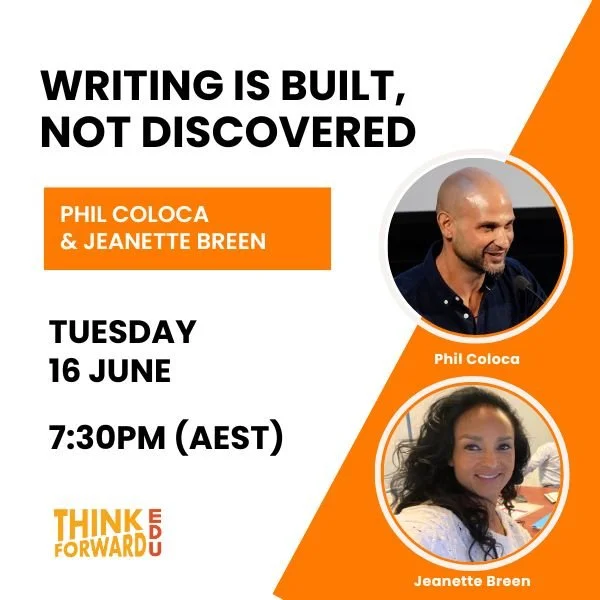
This session focuses on the importance of sequenced curriculum and understanding how a writer develops over time, rather than assuming writing improves through creativity and practice alone.
Phil Coloca and Jeanette Breen explore why students struggle with writing, and how schools can improve outcomes by focusing on sentence-level instruction, modelling, and a carefully sequenced curriculum.
Participants leave with clear, practical approaches to make writing more successful for all students.
To continue the conversation, educators can join our Writing Network via Circle, where ideas, practices, and insights are shared:
We also invite you to contribute to our Writing Survey to help shape and respond to current needs in schools:
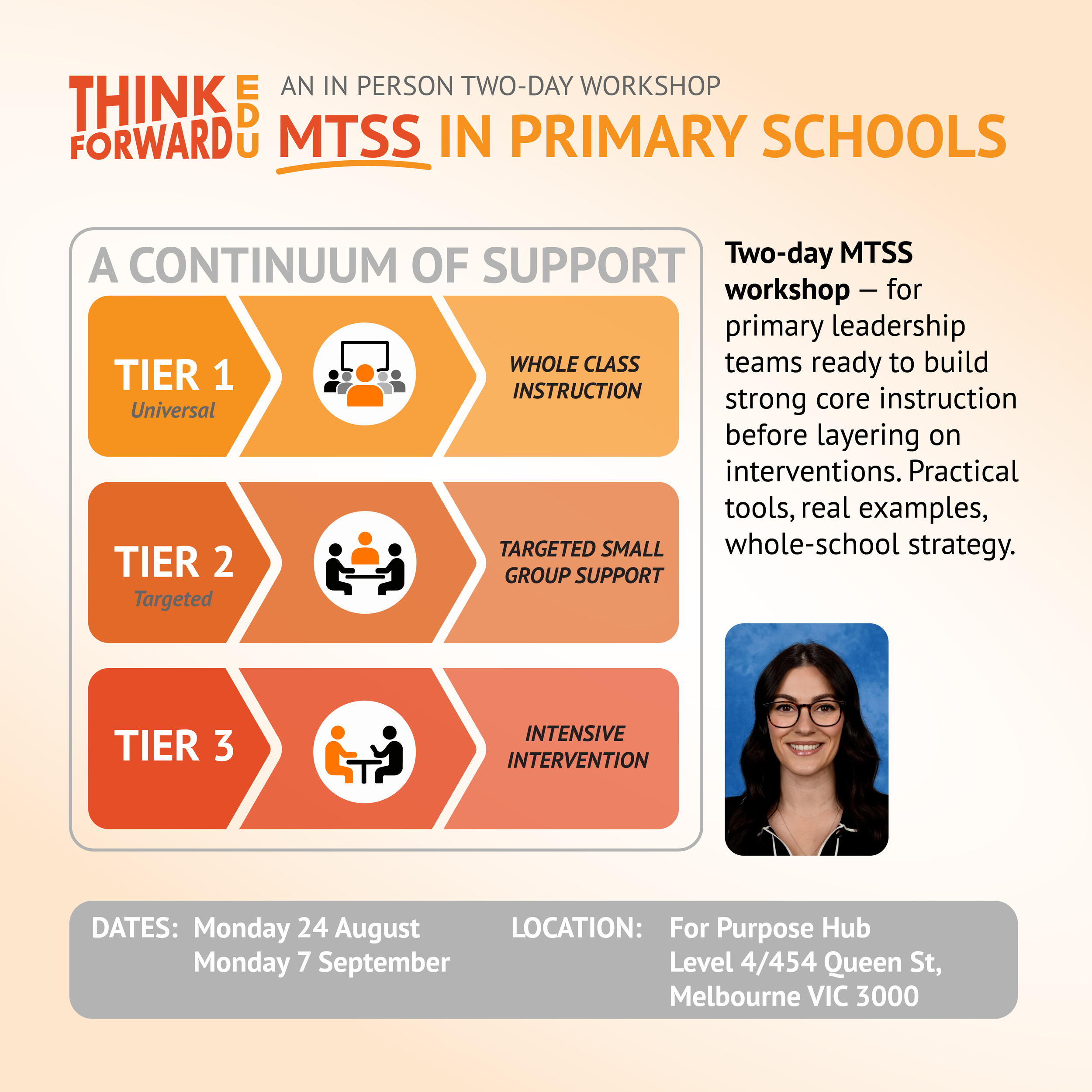
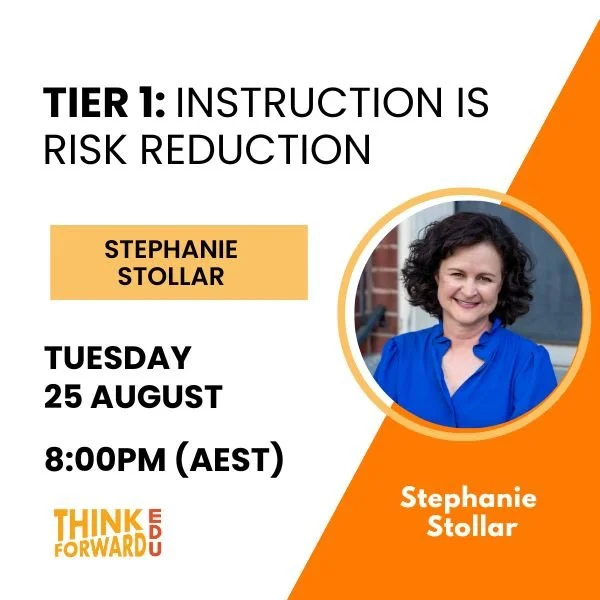
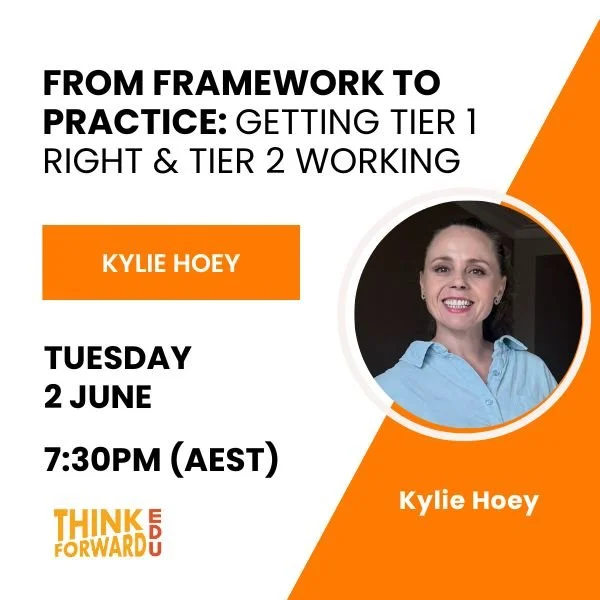
This webinar by Kylie Hoey explores how schools can navigate the complexity of MTSS by prioritising strong Tier 1 instruction while building effective Tier 2 support. It addresses common challenges, including limited resources, timetabling, staffing and what to do if too many students require extra support.
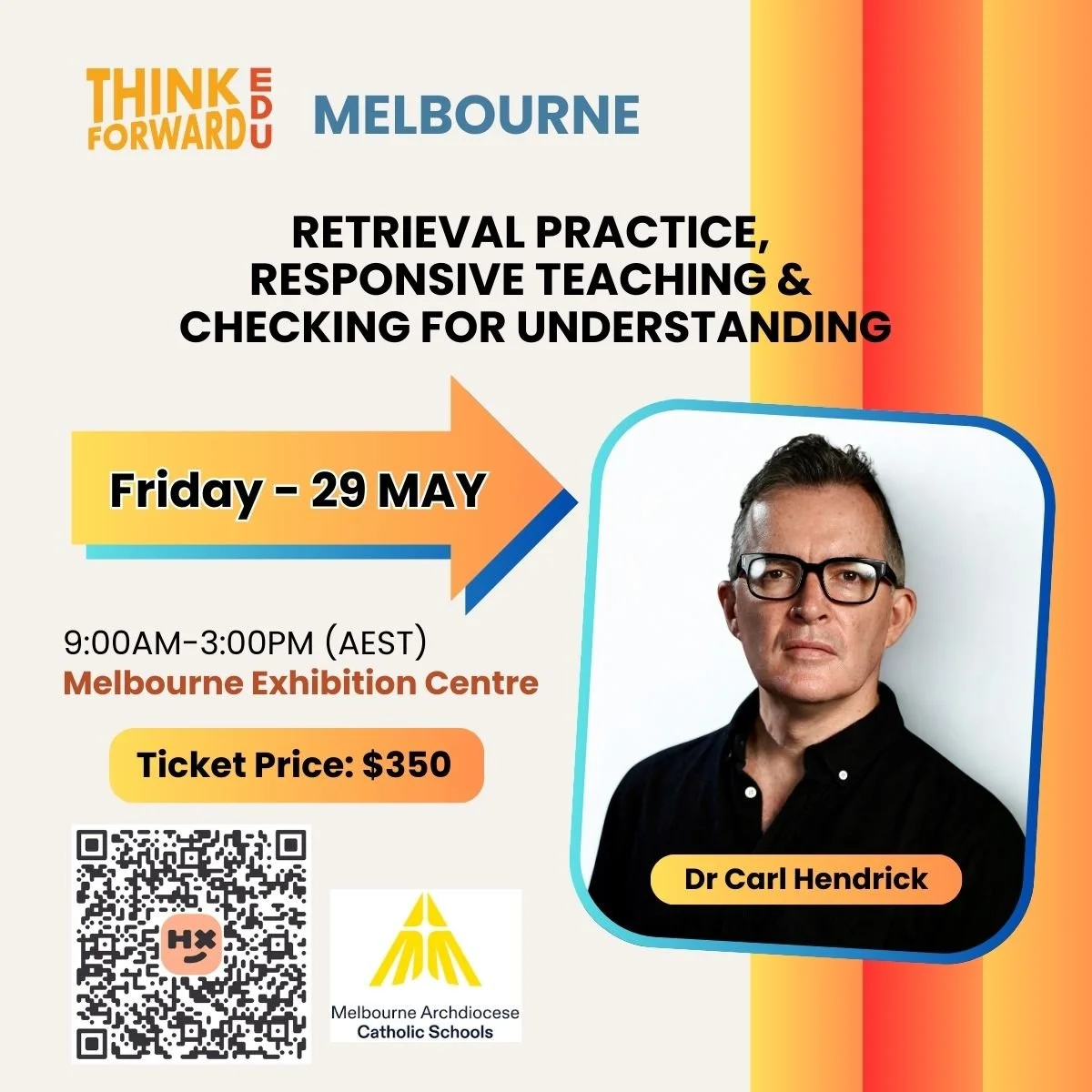
In this session, Dr Carl Hendrick will explore retrieval as a curriculum-wide design feature rather than a starter activity, showing how to build purposeful retrieval streams aligned to curriculum content and avoid low-impact “busy retrieval”.
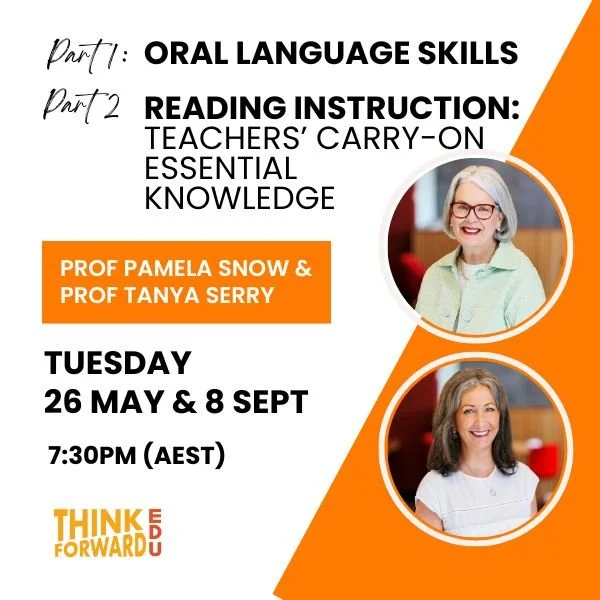
Reading comprehension has been described by Nancy Hennessey* as being like a factory assembly line, taking in a variety of linguistic processes ranging from word decoding through to inferencing and drawing on background knowledge. For this reason, it is essential that teachers understand the language foundations of reading. In this webinar, Hennessey’s metaphor will be used to consider word identification, vocabulary knowledge (including morphology), syntax, figurative/idiomatic language, text-level comprehension, and background knowledge.
In this session, Karina Stocker shares new research exploring what it actually takes to build and sustain MTSS in Victorian schools. Drawing on her recent and emerging work, Karina examines the real-world conditions that enable coherent, school-wide implementation, and the pressures that can quietly undermine it over time.
This session moves beyond theory to focus on implementation: what makes change stick, what makes it fragile, and what leaders and teachers need to consider if MTSS is to deliver on its promise of equity and improved student outcomes. Participants will leave with a clearer lens for diagnosing implementation challenges, strengthening internal systems, and leading sustainable, evidence-informed reform in their schools.
Join us for an introduction to the Read2Learn materials. This session will provide a guided walkthrough of selected units, highlighting how the resources can be implemented effectively within your school context.
Project Leaders Melanie Hart and Samantha Charlton, together with experienced teachers from participating schools, will respond to questions and provide practical guidance for educators seeking to embed Read2Learn within the curriculum and strengthen whole-school literacy practices.
Implementing a Multi-Tiered System of Support (MTSS) in secondary schools presents unique challenges—siloed departments, complex timetables, gaps in foundational skills, subject-specific demands, and adolescent motivation. Drawing on her Churchill Fellowship and experience establishing interventions at Como Secondary College (WA), Jess will share practical strategies and highlight the key non-negotiable pieces of the MTSS puzzle that schools must solve for effective implementation.
Stephanie Dehghani is an Assistant Principal at Templestowe Heights Primary School in Victoria. With over a decade of experience in evidence-based teaching and school leadership, she currently leads whole-school implementation of Multi-Tiered Systems of Support. Steph's focus is on explicit instruction and effective Tier 2 and 3 intervention.
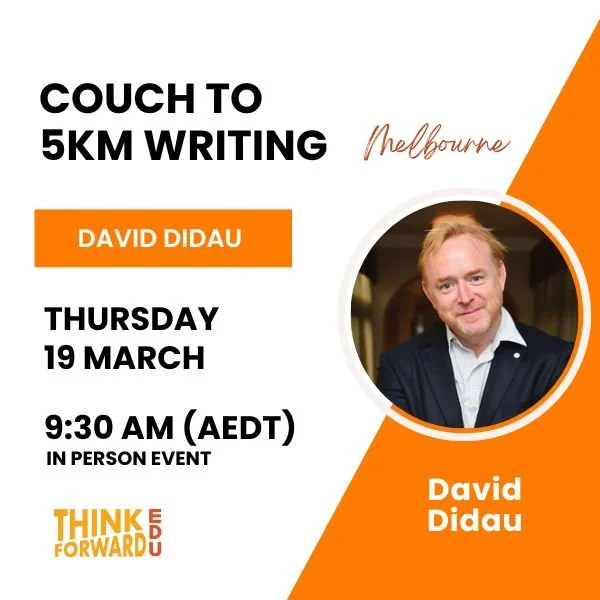
David Didau is an educator, author, and professional learning leader known for his evidence-informed work on teaching, writing, and curriculum. He is the author of several highly regarded books including What If Everything You Knew About Education Was Wrong? and The Secret of Literacy. David writes in his blog The Learning Spy, a widely read platform supporting educators to translate research into classroom practice.
This session explores how structured talk can be used to improve writing, not as a warm up or engagement strategy, but as a cognitive tool. It begins by clarifying the important differences between speech and writing. Talk is transient and socially supported whereas writing is cognitively demanding and depends on a mastery of syntax. Treating them as interchangeable is one reason so much classroom writing fails.
The session will show how carefully designed talk routines can reduce cognitive load, make thinking visible, and give students much needed practice in using academic English. It will demonstrate how to move from oral rehearsal to controlled writing without slipping into vague discussion or unfocused chat. Teachers will leave with practical routines they can use immediately, alongside a clearer sense of when talk helps writing and when it gets in the way.
Building expertise in anything - sports, music, teaching... - requires solid knowledge, adaptable skills, and dependable habits that help us hit the mark without having to think and try too hard in the moment. So what does the Science of Learning say about this in the context of teaching? And what does the evidence tell us about how to help every teacher become even more impactful than they already are? In this webinar, Stuart will answer these questions, providing insights from state-of-the-art research alongside actionable guidance on strategies and techniques to try out in your own practice.
Teachers are often told to be more responsive, more adaptive, and more flexible. But none of that works without strong instructional design.
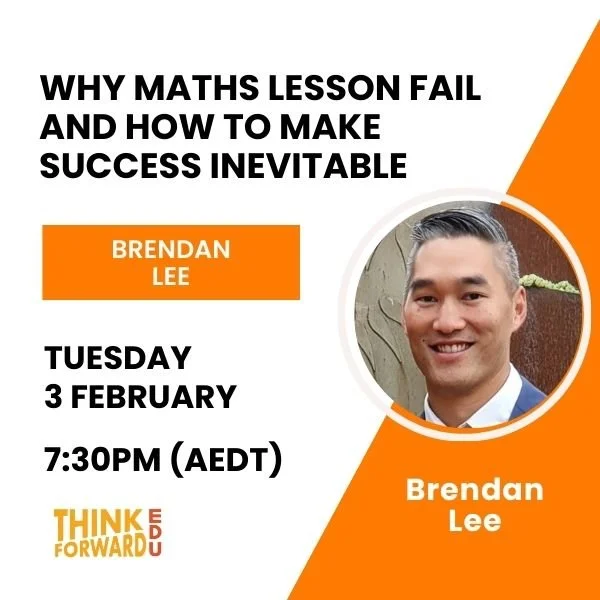
In this session, Brendan will explain why many maths lessons fail, but more importantly unpack what teachers can do to make success inevitable. Participants will develop the knowledge needed to make improvements in their classroom right away.
Join this session to explore how to bring Phonics Plus into your classroom or strengthen your current implementation. You will learn about the key components of Phonics Plus, including phonics, morphology, fluency, and handwriting. Discover practical strategies for implementing lessons and getting started with Phonics Plus.
We will discuss using assessment resources, scaffolds, and extension opportunities for students who are ready for more of a challenge. Supporting resources, including the new slides, will also be covered. Walk away with actionable tips, practical advice, and insights that will help you confidently integrate Phonics Plus into your classroom, fostering stronger reading outcomes, student engagement, and literacy growth for all learners.
This session shares the journey of Rosewood Downs Primary School as it moved from crisis to sustained improvement. It focuses on the practical, research-informed steps taken to build consistent expectations and strengthen both student behaviours and teacher expertise.
in your school. They will unpack whole-school assessment systems and provide practical strategies for leading meetings that change teaching practice using data and feedback for students.
This session builds on Heather’s previous exploration of the features of a knowledge-rich curriculum.
She will delve deeper into how both subject specialists and non-specialists can contribute to the development and quality assurance of a knowledge-rich curriculum.
Heather will examine why studying discrete subjects matters, and why it is essential for curriculum designers, and those teaching a subject, to possess not only subject knowledge but also an understanding of the subject’s curriculum journey - how knowledge builds over time within a discipline.
A key focus will be on one of the most significant ways subjects differ: the divide between hierarchical subjects - where later knowledge depends heavily on secure earlier foundations - and cumulative subjects - where knowledge accrues and broadens but may not follow a strict conceptual sequence.
Heather will explore key principles of curriculum design: breadth (or scope), coherence, components, disciplinary rigor, and memory - and discuss how these can be thoughtfully applied to different subjects to ensure coherence, depth, and long-term retention.
Join Dr. Poncy as he discusses the benefits of declarative fact fluency when teaching mathematics. The fluent retrieval of basic facts provides distinct advantages over the reliance on multistep counting strategies as students work to access and link prior knowledge with new information to expand math skills.
He will review empirical literature that shows five ways fluent responding with a sequenced set of critical skills supports numeracy development:
1) Increased rates of practice/opportunities to respond
2) Increased rates of reinforcement/decreased effort
3) Diminished demands on cognitive load
4) Skill maintenance &
5) Skill generalization
Singularly, each of these are vitally important to student learning, the aggregation of these provides a compelling argument for the necessity of fluent responding with foundational skills. The webinar will conclude with Dr. Poncy providing data from a 5-year longitudinal study which shows the effect of these practices.
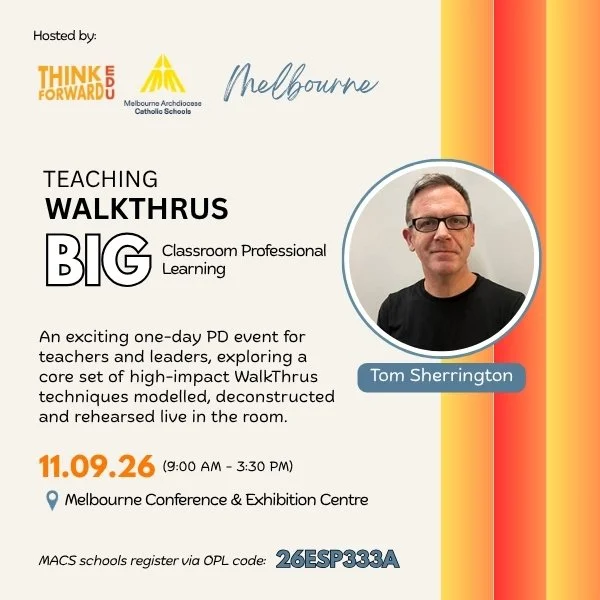
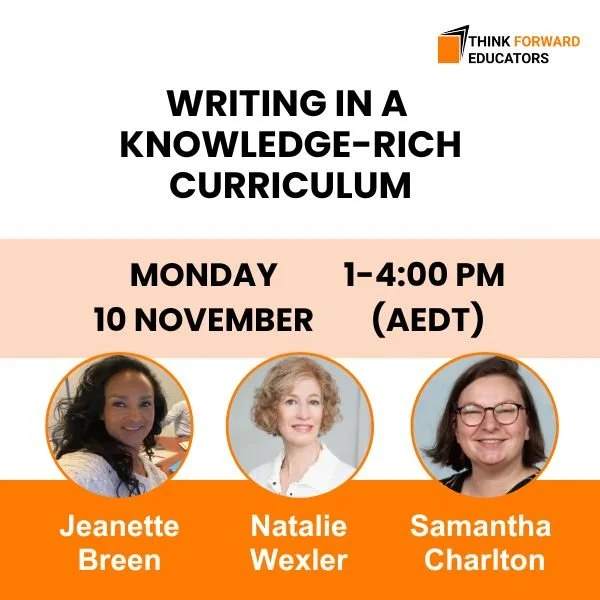
Natalie Wexler will be in Australia in November, and Think Forward Educators are privileged to host her in Melbourne for a three-hour event on Monday, 10 Nov. Equity in education is at the heart of TFE’s work, and we encourage you to be part of Natalie’s message on the importance of knowledge, the links to writing, and contextual examples of how classroom practice can be transformed.
Natalie Wexler will be joined by Jeanette Breen and Samantha Charlton of Templestowe Heights Primary School and Think Forward Educators, who will show how The Writing Revolution techniques are applied in context; privileging knowledge-rich curriculum, strong writing frameworks, and transforming classroom practice.
Think Forward Educators in-person: Writing Professional Learning Events in Canberra and Melbourne.
Natalie Wexler, co-author of The Writing Revolution will be in Australia in November, and Think Forward Educators are privileged to host her in Canberra Friday, Nov 7 and Melbourne Monday, 10 Nov.
Equity in education is at the heart of TFE’s work, and we encourage you to be part of Natalie’s message on the importance of knowledge, the links to writing, and contextual examples of how classroom practice can be transformed.
Get tickets for Canberra here and tickets for Melbourne here.
This online professional learning session will bring together teachers and school leaders from small schools to share how they structure and deliver mathematics in their unique contexts. We will be exploring class structures, typical lesson approaches, key influences on practice, and planning processes such as scope and sequence design or intervention supports.
Teachers will also reflect on challenges faced and outline their next steps, offering practical insights and ideas transferable to other small school settings. This webinar responds to strong demand from regional and rural schools for professional learning that highlights explicit mathematics teaching in small school environments.
Think Forward Educators invites teachers and leaders to a dynamic webinar exploring the role of the principal as lead learner, framed through the VTLM 2.0 guide for Leading a Whole School Approach.
In this session we will hear from Jacqui Burrows (Churchill PS), Rhys Coulson (Templestowe Heights PS), Sarah Asome (Bentleigh West PS) & Steve Capp (Chelsea Heights PS) to gain practical insights into leading curriculum and instructional change, building capacity, and modelling the professional learning that drives whole-school success.
For mathematics instruction to reach its full potential in any school, the school must have a dual focus on both the 'what' and the 'how'. The 'what' is curriculum, the thoughtfully curated, sequenced, and planned content that is to be learnt by students. The 'how' is instruction, the way in which that curriculum is to be enacted in the classroom to maximise students' cognitive engagement and learning. Last year, Ollie, Toni and Dave's TFE presentation on the 'what', Explicit Mathematics Teaching - Unlocking the science of mathematics in the primary classroom, really hit the mark, and was TFE's biggest webinar ever with over 700 registrants.
This year these three renowned educators are back to focus on that second crucial piece of the mathematics puzzle, the 'how'. In this session, Ollie, Toni, and Dave will take you through key instructional practices in your classroom to get the most out of your students regardless of the specific lessons you're teaching. This is a unique opportunity to learn from three key thought leaders in this space and is not to be missed.
🚨 Tickets now available!
Join us for Essential Insights for Teaching Maths Effectively — a full day of expert-led sessions packed with practical strategies for the classroom.
📅 Saturday 13 September
📍 Dandenong West Primary School
🎟️ $125 per ticket
Hear from 10 inspiring presenters sharing what really works in maths education.
📲 Scan the QR code to get your tickets now!
#MathsEducation #TFEevent #ProfessionalLearning #TeachingMathematics
After Serpentine Primary School shared their fluency program (Maths Ninjas), Kat led the development of this into a targeted 15 minute maths fluency block at her school. She is slowly making all 1700+ resources she developed publicly and freely available. Kat believes all students deserve high quality maths fluency instruction - and all teachers deserve the right to high quality resources to support this.
In Session 2, Kat will model the Ninja Belts (timed testing) system, justify the adaptations made since the original development at Serpentine, and discuss the excitement levels for fluency from the school community. She will address common misconceptions about delivery, model practical setup and how to reduce the administration time. Kat will share the tracking and assessment systems used to monitor individual student progress and whole-school impact.
This session will provide deeper insight into the Mathematics Lesson Plans developed by the Victorian Department of Education. Sacha will discuss the Victorian Maths position statement and outline the approach to the lessons and resources that have been released to support schools with teaching maths explicitly. The Victorian Lesson Plans are freely available to all educators and this session is open to educators across Australia.
This session explores the essential role of the Instructional Hierarchy in supporting effective learning. Sean unpacks its four stages and outlines how different teaching approaches align with each phase of learning. Using practical examples from primary classrooms, he demonstrates how the framework can inform lesson planning and delivery to support equitable outcomes for all students.
The session also tackles a key question in education: when to teach explicitly and when to use a problem-solving approach—highlighting the value of both within the learning process.
Learn about the techniques that enable learners to engage in efficient Discussions, respond to rigorous Questioning, and thrive in a culture of continual learning through effective Check for Understanding (CFU).
After Serpentine Primary School shared their fluency program (Maths Ninjas), Kat led the development of this into a targeted 15 minute maths fluency block at her school. She is slowly making all 1700+ resources she developed publicly and freely available. Kat believes all students deserve high quality maths fluency instruction - and all teachers deserve the right to high quality resources to support this.
In Session 1, Kat will demonstrate how she has incorporated her knowledge of fluency research and inspiration from other maths fluency materials to develop sequenced strategy instruction and practice materials. Informed by the Instructional Hierarchy and following the Gradual Release of Responsibility framework weekly, Kat will model how she systematically builds fact fluency across fact sets. She will reflect on what she has learnt about implementation and how best to support teachers.
Lasting literacy impact requires more than phonics alone. This practical demonstration outlines an integrated approach combining phonics, morphology, orthography, syntax, and etymology. Lyn Stone guides participants through the Four-Step Process used in schools and in her practice to help students study words in depth. The session includes a ready-to-use resource and shows how to connect linguistic and background knowledge to support learners of all ages and abilities.
What do you know about the history of cognitive science? How familiar are you with the savage battles between "behaviourism" and "mentalism" that took place in the mid-20th century? Would you believe that a book review by Noam Chomsky played a pivotal role? And what does any of this have to do with teaching today? Quite a bit, actually, or so Benjamin Riley will try to persuade you in this provocative session.