Science of learning for excellence and equity
Welcome to our community.
Think Forward Educators is a community of over 30,000 teachers, school leaders, specialists, parents, and researchers. We advocate for education that allows every child to succeed: Promoting social equity, using the science of learning.
Upcoming Events
Building expertise in anything - sports, music, teaching... - requires solid knowledge, adaptable skills, and dependable habits that help us hit the mark without having to think and try too hard in the moment. So what does the Science of Learning say about this in the context of teaching? And what does the evidence tell us about how to help every teacher become even more impactful than they already are? In this webinar, Stuart will answer these questions, providing insights from state-of-the-art research alongside actionable guidance on strategies and techniques to try out in your own practice.
This session explores how structured talk can be used to improve writing, not as a warm up or engagement strategy, but as a cognitive tool. It begins by clarifying the important differences between speech and writing. Talk is transient and socially supported whereas writing is cognitively demanding and depends on a mastery of syntax. Treating them as interchangeable is one reason so much classroom writing fails.
The session will show how carefully designed talk routines can reduce cognitive load, make thinking visible, and give students much needed practice in using academic English. It will demonstrate how to move from oral rehearsal to controlled writing without slipping into vague discussion or unfocused chat. Teachers will leave with practical routines they can use immediately, alongside a clearer sense of when talk helps writing and when it gets in the way.
Many classrooms treat retrieval practice as a "bolt-on" activity—a quick quiz or a five-minute starter. However, to truly impact long-term mastery, retrieval must move from a peripheral task to the very architecture of the course.
This session explores how to transition from "doing" retrieval to building a cohesive, curriculum-led system that identifies not just what students remember, but how that memory shapes future learning.
Dismantling the flawed assumption that writing is a generic skill that students can simply ‘pick up’ through exposure or repetition, this workshop proposes a model of explicit instruction, deliberate practice, and curriculum alignment, offering a tightly structured approach to writing instruction that breaks down complex skills into teachable steps. Grounded in cognitive science, grammar instruction, and classroom-tested routines.
In this session, Dr Carl Hendrick will explore retrieval as a curriculum-wide design feature rather than a starter activity, showing how to build purposeful retrieval streams aligned to curriculum content and avoid low-impact “busy retrieval”.
David Didau is an educator, author, and professional learning leader known for his evidence-informed work on teaching, writing, and curriculum. He is the author of several highly regarded books including What If Everything You Knew About Education Was Wrong? and The Secret of Literacy. David writes in his blog The Learning Spy, a widely read platform supporting educators to translate research into classroom practice.
Stephanie Dehghani is an Assistant Principal at Templestowe Heights Primary School in Victoria. With over a decade of experience in evidence-based teaching and school leadership, she currently leads whole-school implementation of Multi-Tiered Systems of Support. Steph's focus is on explicit instruction and effective Tier 2 and 3 intervention.
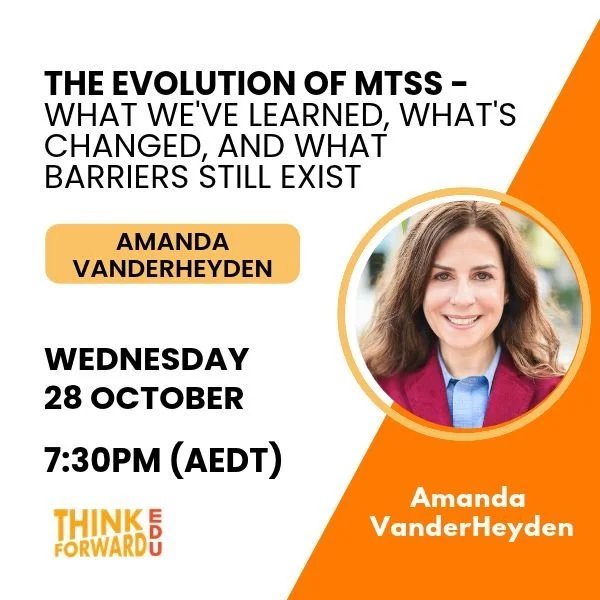
Implementing a Multi-Tiered System of Support (MTSS) in secondary schools presents unique challenges—siloed departments, complex timetables, gaps in foundational skills, subject-specific demands, and adolescent motivation. Drawing on her Churchill Fellowship and experience establishing interventions at Como Secondary College (WA), Jess will share practical strategies and highlight the key non-negotiable pieces of the MTSS puzzle that schools must solve for effective implementation.
“Think Forward Educators helped build my confidence and stopped me from feeling like I was alone on my quest for knowledge that was evidence-based."
— Middle leader at a government primary school in NSW

Think Forward Blog

The announcement from Deputy Premier and Education Minister Ben Carroll on Thursday is welcomed by Think Forward Educators members who are pleased to see evidence-aligned instruction so strongly supported by policy leaders in Victoria. This is good news and a great first step in the right direction.
There has been a lot of recent commentary about student behaviour in schools and what teachers should do about it. We thought it might be useful to share a series of five “memes” over the coming days that may enhance a teacher’s ability to understand and implement evidence-based behaviour support practices in their classroom. Each meme is based on a significant body of research evidence and may be used to add depth or breadth to practices that you are familiar with already (such as explicit instruction and opportunities to respond).
Comparative Judgement is an innovative new assessment that has recently become available in Australia. Traditional marking, including NAPLAN Writing, involves the use of a rubric. Comparative Judgement relies on many educators comparing one script to another until a continuum of scripts is formed. To understand if Comparative Judgement can be a useful predictor for national writing assessment, No More Marking are able to make some interesting correlations.
A message from Think Forward Educators founder Dr Nathaniel Swain
Introducing Katie Roberts-Hull, the new Think Forward Educators CEO
An overarching problem encountered in many classrooms is having our students write the way they speak. Why do they do this?
Language acquisition is a biologically primary skill, meaning humans will naturally learn how to speak. However, the written word is a skill that must be taught.
Following on from last year’s successful series of blog articles on 5 ways to implement the science of reading, this year experts will be providing ready-to-use tips on the science of maths.
Inspired by Tom Sherrington’s Five Ways Collection, the posts have been edited and curated by Brendan Lee and Dr Nathaniel Swain.
The first blog post of the series comes from maths guru, Alex Blanksby.
Following on from last year’s successful series of blog articles on 5 ways to implement the science of reading, this year experts will be providing ready-to-use tips on the science of maths.
Inspired by Tom Sherrington’s Five Ways Collection, the posts have been edited and curated by Brendan Lee and Dr Nathaniel Swain.
The second blog post of the series comes from maths guru, Karen Tzanetopoulos.
Following on from last year’s successful series of blog articles on 5 ways to implement the science of reading, this year experts will be providing ready-to-use tips on the science of maths.
Inspired by Tom Sherrington’s Five Ways Collection, the posts have been edited and curated by Brendan Lee and Dr Nathaniel Swain.
The first blog post of the series comes from maths guru, Alex Blanksby.
What is the best way of reporting assessment information to students & parents? This is a question I hear all the time, and it isn’t easy to answer. What we all want is an assessment system that is (a) accurate, (b) easy to understand, (c) not too time-consuming for staff, and (d) motivating for students. But these principles are all in conflict with each other.
This article from Brendan Lee looks at what we can do to support school leaders in implementing the science of learning.
So what is Developmental Language Disorder (DLD)? According to data from the SCALES Project, led by Professor Courtney Norbury, it affects 1 in 14 children, which equates to approximately 2 children in every classroom. Each person’s language profile will look different but common features include difficulties with:
Learning and using new words, Word finding, Understanding and using complex sentences, Understanding the nuances of conversation, Working memory, Reading. Chances are that someone in your everyday life has this hidden condition. Please take the time to learn a little more. It could make all the difference.
Think Forward Educators is posting a series of blog articles written by educational experts providing ready-to-use tips on how to implement the Science of Reading into the classroom. Inspired by Tom Sherrington’s Five Ways Collection, the posts have been edited and curated by Brendan Lee and Dr Nathaniel Swain. This blog post on Oral Language comes from teacher and speech-language pathologist, Kathryn Thorburn.
Research ⟺ Practice
We see oral language and literacy skills as fundamental to all teaching and learning.
The Science of Learning and Science of Reading provide a roadmap for educators to ensure that all students can succeed.
More is known about how children learn than ever before. Our mission is to get this knowledge into the hands of all educators.
Join our community
Join our community of educators to attend our next event, follow our discussion boards, and watch event recordings.
All are welcome! Access to our community platform is free.
“Educators using the science of learning are sending waves across the education system.
Our goal is to see the tides change on every shore.”
— Dr Nathaniel Swain, Founder and Chair
Contact
Want to advertise in our newsletter?
Our weekly newsletter goes out to over 20,000 educators across Australia. If your ad relates to the science of learning, contact us to discuss pricing for newsletter ads.
contact@thinkforwardeducators.org
Feel free to contact us with any questions.
Email
contact@thinkforwardeducators.org
Got a school-based job you want to post?
You can do this in our job board on our app: Click Here
You first have to create a free account on our Circle platform.

Why are schools pursuing the Workshop Model for young students? The Workshop model entails students working through the writing process to learn the art of being an author through editing and revising. The difficulty here is one of mass differentiation. Here are the practical things we need to consider in the implementation of shifting to an explicit writing model.