
What does research tell us about effective teaching? Which strategies are more powerful than we tend to think? This session will offer a framework of 5 evidence informed strategies which teachers can use to boost learning, motivation, and equity in school.

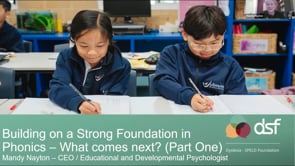
Everyone who implements MTSS for reading improvement understands that Tier 1 is the foundation of success. But what does this really mean in practice in primary schools?
This webinar will expose 3 common misunderstandings about the Tier 1 system of reading support including mandates to implement Tier 1 with fidelity, expose students to grade-level standards, and provide only whole group phonics instruction.
Participants will explore how to use screening, diagnostic, and progress monitoring data to build a Tier 1 system that reduces risk, minimizes the need for intervention, closes gaps, and meets the needs of all students.
As students move from the early years into middle and upper primary, there is a sharp increase in the number of complex (abstract) words they are likely to encounter in text - and that they will be expected to use in their writing. Most of these words are either Latin or Greek in origin, include orthographic patterns that differ from those found in everyday Anglo-Saxon words and rely heavily on morphemes.
Students who are aware of these structural changes (and the history behind them) are consistently more accurate readers and spellers - and are more likely to develop a larger and more connected vocabulary. This in turn contributes to stronger reading comprehension and elevated written expression skills.
In these sessions, participants will take a crash course in the history of English and will explore the question ‘What is lexical quality?’ In addition, an overview of instructional practices designed to improve both spelling and vocabulary development in the mid/upper primary years will be provided.
As explicit instruction gains momentum across Australia, it has been accompanied by some vocal cries against differentiation. Yet research indicates that gifted and high potential students benefit from grouping with peers and experience negative academic and socio-emotional outcomes when instruction is not differentiated.
This session first examines this conundrum through the evidence around differentiation and ability grouping, before exploring strategies that transform theoretical best practice into immediate classroom application. We’ll delve into methods to add depth and abstraction, encourage higher-order thinking and generate low entry-high ceiling tasks that provide stretch for gifted students. K-12 illustrations make this relevant and practical for all teachers.
