In the last couple of years, Large Language Models (LLMs) have disrupted many aspects of assessment. AI plagiarism is a threat to the integrity of many traditional assessments, but AI grading and feedback tools promise to reduce teacher workload and provide rapid and extensive feedback. What is the hype and what is reality? Can AI mark accurately? Can it provide useful feedback that helps students improve?
How do we avoid the dystopian future where students use AI to write essays that AI marks? In this session, Daisy Christodoulou will outline the latest research in this area, including No More Marking's pioneering research with over 1,000 schools in England.
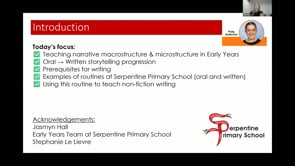
This session showcased Serpentine Primary School’s structured approach to developing emergent writers in the early years. Polly Anderson shared practical routines that use oral language, syntax, picture sequences, and macrostructure icons to support writing development. Participants explored differentiation strategies and scaffolded instruction that gradually builds student independence in narrative and information writing.

This session explored how structured talk can be used to improve writing, not as a warm up or engagement strategy, but as a cognitive tool. It began by clarifying the important differences between speech and writing. Talk is transient and socially supported whereas writing is cognitively demanding and depends on a mastery of syntax. Treating them as interchangeable is one reason so much classroom writing fails.
This session focused on the importance of sequenced curriculum and understanding how a writer develops over time, rather than assuming writing improves through creativity and practice alone.
Phil Coloca and Jeanette Breen explored why students struggle with writing, and how schools can improve outcomes by focusing on sentence-level instruction, modelling, and a carefully sequenced curriculum.
Participants left with clear, practical approaches to make writing more successful for all students.
