
What does research tell us about effective teaching? Which strategies are more powerful than we tend to think? This session will offer a framework of 5 evidence informed strategies which teachers can use to boost learning, motivation, and equity in school.
What does Tier 1 mean for a specialist setting? What does this look like when a lot of the MTSS resources and examples are tailored for mainstream schools? Join Charlotte to learn about implementing MTSS with fidelity at Tier 1, Tier 2 and Tier 3 in specialist settings. With a wealth of knowledge and practical experience.
Charlotte aimed to break down the barriers, simplify the research into "the best bang for your buck" and discover what works best for all students in schools.

Everyone who implements MTSS for reading improvement understands that Tier 1 is the foundation of success. But what does this really mean in practice in primary schools?
This webinar will expose 3 common misunderstandings about the Tier 1 system of reading support including mandates to implement Tier 1 with fidelity, expose students to grade-level standards, and provide only whole group phonics instruction.
Participants will explore how to use screening, diagnostic, and progress monitoring data to build a Tier 1 system that reduces risk, minimizes the need for intervention, closes gaps, and meets the needs of all students.
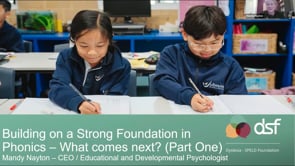
As students move from the early years into middle and upper primary, there is a sharp increase in the number of complex (abstract) words they are likely to encounter in text - and that they will be expected to use in their writing. Most of these words are either Latin or Greek in origin, include orthographic patterns that differ from those found in everyday Anglo-Saxon words and rely heavily on morphemes.
Students who are aware of these structural changes (and the history behind them) are consistently more accurate readers and spellers - and are more likely to develop a larger and more connected vocabulary. This in turn contributes to stronger reading comprehension and elevated written expression skills.
In these sessions, participants will take a crash course in the history of English and will explore the question ‘What is lexical quality?’ In addition, an overview of instructional practices designed to improve both spelling and vocabulary development in the mid/upper primary years will be provided.
As explicit instruction gains momentum across Australia, it has been accompanied by some vocal cries against differentiation. Yet research indicates that gifted and high potential students benefit from grouping with peers and experience negative academic and socio-emotional outcomes when instruction is not differentiated.
This session first examines this conundrum through the evidence around differentiation and ability grouping, before exploring strategies that transform theoretical best practice into immediate classroom application. We’ll delve into methods to add depth and abstraction, encourage higher-order thinking and generate low entry-high ceiling tasks that provide stretch for gifted students. K-12 illustrations make this relevant and practical for all teachers.
In the last couple of years, Large Language Models (LLMs) have disrupted many aspects of assessment. AI plagiarism is a threat to the integrity of many traditional assessments, but AI grading and feedback tools promise to reduce teacher workload and provide rapid and extensive feedback. What is the hype and what is reality? Can AI mark accurately? Can it provide useful feedback that helps students improve?
How do we avoid the dystopian future where students use AI to write essays that AI marks? In this session, Daisy Christodoulou will outline the latest research in this area, including No More Marking's pioneering research with over 1,000 schools in England.
This session focused on the importance of sequenced curriculum and understanding how a writer develops over time, rather than assuming writing improves through creativity and practice alone.
Phil Coloca and Jeanette Breen explored why students struggle with writing, and how schools can improve outcomes by focusing on sentence-level instruction, modelling, and a carefully sequenced curriculum.
Participants left with clear, practical approaches to make writing more successful for all students.
This webinar by Kylie Hoey explored how schools can navigate the complexity of MTSS by prioritising strong Tier 1 instruction while building effective Tier 2 support. It addressed common challenges, including limited resources, timetabling, staffing and what to do if too many students require extra support.

Reading comprehension involves a range of language processes, from word decoding and vocabulary knowledge to inferencing and background knowledge. In this webinar, Nancy Hennessey’s "factory assembly line" metaphor is used to explore the key language foundations of reading, including word identification, morphology, syntax, figurative language, text comprehension and background knowledge.
In this session, Karina Stocker shared emerging research on building and sustaining Multi-Tiered Systems of Support (MTSS) in Victorian schools. Focusing on practical implementation, she explored the conditions that support lasting change, common barriers to success, and strategies for strengthening school systems to achieve equitable and improved student outcomes.
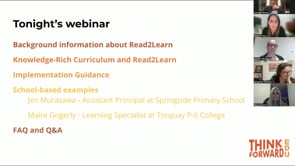
An introduction to the Read2Learn materials, this session provided a guided walkthrough of selected units, highlighting how the resources can be implemented effectively within your school context.
Project Leaders Melanie Hart and Samantha Charlton, together with experienced teachers from participating schools, responded to questions and provided practical guidance for educators seeking to embed Read2Learn within the curriculum and strengthen whole-school literacy practices.

Implementing a Multi-Tiered System of Support (MTSS) in secondary schools presents unique challenges - siloed departments, complex timetables, gaps in foundational skills, subject-specific demands, and adolescent motivation. Drawing on her Churchill Fellowship and experience establishing interventions at Como Secondary College (WA), Jess shared practical strategies and highlighted the key non-negotiable pieces of the MTSS puzzle that schools must solve for effective implementation.
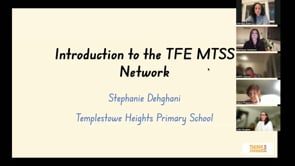
This webinar explored how to build effective MTSS by strengthening Tier 1 and designing Tier 2 support as an extra dose of core instruction, not a separate program. Stephanie will shared practical examples of alignment, dosage, and the strategic use of staff, grounded in cognitive science and explicit instruction.
The session also marked the launch of the MTSS Network on Think Forward Educators (TFE).

This session explored how structured talk can be used to improve writing, not as a warm up or engagement strategy, but as a cognitive tool. It began by clarifying the important differences between speech and writing. Talk is transient and socially supported whereas writing is cognitively demanding and depends on a mastery of syntax. Treating them as interchangeable is one reason so much classroom writing fails.

Expertise in teaching, like in sport or music, relies on strong knowledge, adaptable skills, and effective habits. In this webinar, Stuart Kime explores what the Science of Learning reveals about developing teaching expertise and helping every teacher become more impactful. Drawing on the latest research, he shares practical, evidence-informed strategies that educators can apply immediately in their own classrooms.
Sacha & Reid unpack whole-school assessment systems and provide practical strategies for leading meetings that change teaching practice using data and feedback for students.

Teachers are often told to be more responsive, more adaptive, and more flexible. But none of that works without strong instructional design. In this session, Brendan will explain why many maths lessons fail, but more importantly unpack what teachers can do to make success inevitable. Participants will develop the knowledge needed to make improvements in their classroom right away.

This session explored how to implement or strengthen the use of Phonics Plus in your classroom. Learn about its key components—phonics, morphology, fluency, and handwriting—and discover practical lesson strategies, assessment tools, scaffolds, and extension opportunities. Gain actionable tips, insights into supporting resources, and confidence to enhance reading outcomes, engagement, and literacy growth for all learners.
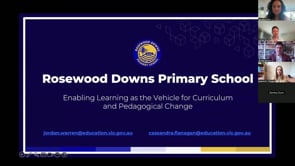
This session explored the improvement journeys of Rosewood Downs Primary School and Dandenong West Primary School.
Participants explored how research-informed practices, consistent expectations, whole-school routines, explicit instruction, and cognitive science were used to strengthen teacher expertise, improve student behaviour, build a shared professional language, and create calm, purposeful learning environments that support stronger learning outcomes for all students.
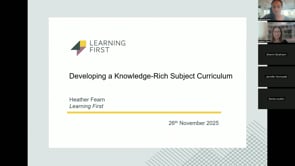
This session explored how subject specialists and non-specialists can contribute to knowledge-rich curriculum design. Heather examined curriculum progression, the differences between hierarchical and cumulative subjects, and key principles such as coherence, disciplinary rigour, and memory. Participants gained practical insights into designing curricula that build deep understanding and support long-term retention.

Dr. Poncy discussed the benefits of declarative fact fluency when teaching mathematics. The fluent retrieval of basic facts provides distinct advantages over the reliance on multistep counting strategies as students work to access and link prior knowledge with new information to expand math skills.

This online professional learning session will bring together teachers and school leaders from small schools to share how they structure and deliver mathematics in their unique contexts. We will be exploring class structures, typical lesson approaches, key influences on practice, and planning processes such as scope and sequence design or intervention supports.
Think Forward Educators invites teachers and leaders to a dynamic webinar exploring the role of the principal as lead learner, framed through the VTLM 2.0 guide for Leading a Whole School Approach.
In this session we will hear from Jacqui Burrows, Rhys Coulson, Sarah Asome & Steve Capp to gain practical insights into leading curriculum and instructional change, building capacity, and modelling the professional learning that drives whole-school success.

For mathematics instruction to reach its full potential in any school, the school must have a dual focus on both the 'what' and the 'how'. The 'what' is curriculum, the thoughtfully curated, sequenced, and planned content that is to be learnt by students. The 'how' is instruction, the way in which that curriculum is to be enacted in the classroom to maximise students' cognitive engagement and learning.
In Session 2, Kat will model the Ninja Belts (timed testing) system, justify the adaptations made since the original development at Serpentine, and discuss the excitement levels for fluency from the school community. She will address common misconceptions about delivery, model practical setup and how to reduce the administration time. Kat will share the tracking and assessment systems used to monitor individual student progress and whole-school impact.
This session provided deeper insight into the Mathematics Lesson Plans developed by the Victorian Department of Education. Sacha discussed the Victorian Maths position statement and outlined the approach to the lessons and resources that have been released to support schools with teaching maths explicitly. The Victorian Lesson Plans are freely available to all educators and this session is open to educators across Australia.
This session explored the essential role of the Instructional Hierarchy in supporting effective learning. Sean unpacked its four stages and outlines how different teaching approaches align with each phase of learning. Using practical examples from primary classrooms, he demonstrated how the framework can inform lesson planning and delivery to support equitable outcomes for all students.
Learn about the techniques that enable learners to engage in efficient Discussions, respond to rigorous Questioning, and thrive in a culture of continual learning through effective Check for Understanding (CFU).
In Session 1, Kat will demonstrate how she has incorporated her knowledge of fluency research and inspiration from other maths fluency materials to develop sequenced strategy instruction and practice materials. Informed by the Instructional Hierarchy and following the Gradual Release of Responsibility framework weekly, Kat will model how she systematically builds fact fluency across fact sets. She will reflect on what she has learnt about implementation and how best to support teachers.
Lasting literacy impact requires more than phonics alone. This practical demonstration outlines an integrated approach combining phonics, morphology, orthography, syntax, and etymology.
Lyn Stone guides participants through the Four-Step Process used in schools and in her practice to help students study words in depth.
The session includes a ready-to-use resource and shows how to connect linguistic and background knowledge to support learners of all ages and abilities.

What do you know about the history of cognitive science? How familiar are you with the savage battles between "behaviourism" and "mentalism" that took place in the mid-20th century? Would you believe that a book review by Noam Chomsky played a pivotal role? And what does any of this have to do with teaching today? Quite a bit, actually, or so Benjamin Riley tries to persuade you in this provocative session.

Grattan Institute is about to publish a guide on how to implement great maths teaching in primary schools. The practical, easy-to-follow guide complements Grattan Institute’s recent report, The Maths Guarantee: How to boost students’ learning in primary schools. In this presentation, Amy Haywood and Nick Parkinson will share Grattan’s summary of the evidence base and distil lessons from seven case study schools that have successfully translated the evidence into practice.

Screening assessments like DIBELS are increasingly used in English. But what about for maths? This session outlines the experience of Docklands Primary School in using Acadience Math, an example of universal screening assessment. Learn more about the assessment and how it can be used to support school improvement.
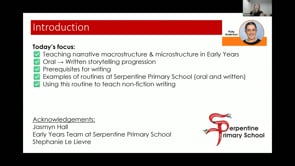
This session showcased Serpentine Primary School’s structured approach to developing emergent writers in the early years. Polly Anderson shared practical routines that use oral language, syntax, picture sequences, and macrostructure icons to support writing development. Participants explored differentiation strategies and scaffolded instruction that gradually builds student independence in narrative and information writing.
In this session Heather goes back to first principles and explore why knowledge matters and what is meant by a knowledge-rich curriculum. She discussed what this means for teachers and especially the implications of adopting a knowledge-rich curriculum for lesson design. She considered some of the most common pitfalls when trying to adopt a knowledge-rich approach, for example, moving onto task design without clarity about content choices at different levels of granularity.
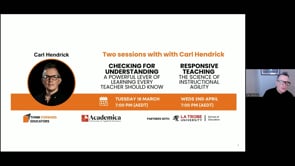
This session will examine how teachers can use real-time feedback to guide their teaching, making learning more effective and targeted. Using insights from cognitive load theory, spaced learning, and scaffolding, we’ll discuss how to respond to student needs, address misconceptions, and adjust instructional strategies on the spot.
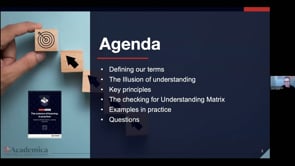
Checking for Understanding
This session tackles one of education's most crucial challenges: accurately assessing student comprehension in real-time. Drawing on research from cognitive science, this session will explore effective strategies for formative assessment, including retrieval practice, diagnostic questioning, and the use of misconceptions as learning opportunities. Participants will leave with practical techniques to make student thinking visible and adjust instruction accordingly.
This session explores Teach Like a Champion's latest guidance on reading pedagogy with a practical look at building knowledge to increase reading comprehension.
Learn about four key tools that allow for strategic and purposeful use of background knowledge:
embedded non-fiction texts
embellishments
knowledge organisers and
vocabulary as knowledge.
This session unpacks what is included in explicit Maths lessons that aligns with the VTLM 2.0. Look at evidence-based instructional models that we can draw upon to ensure that our practices align, as well as what this looks like when we are planning and teaching.
Key points included will be:
Review practices
Explicitly teaching new content
Guided and independent practice
Developing fluency
Assessing within lessons
This session is designed to help teachers enhance their classroom strategies by pairing bar models with abstract calculations, improving students' clarity in problem-solving. Learned how bar models can become the essential scaffold between concrete manipulatives and abstract concepts, solidifying core mathematical understanding for all learners.
