As students move from the early years into middle and upper primary, there is a sharp increase in the number of complex (abstract) words they are likely to encounter in text - and that they will be expected to use in their writing. Most of these words are either Latin or Greek in origin, include orthographic patterns that differ from those found in everyday Anglo-Saxon words and rely heavily on morphemes.
Students who are aware of these structural changes (and the history behind them) are consistently more accurate readers and spellers - and are more likely to develop a larger and more connected vocabulary. This in turn contributes to stronger reading comprehension and elevated written expression skills.
In these sessions, participants will take a crash course in the history of English and will explore the question ‘What is lexical quality?’ In addition, an overview of instructional practices designed to improve both spelling and vocabulary development in the mid/upper primary years will be provided.
Lasting literacy impact requires more than phonics alone. This practical demonstration outlines an integrated approach combining phonics, morphology, orthography, syntax, and etymology.
Lyn Stone guides participants through the Four-Step Process used in schools and in her practice to help students study words in depth.
The session includes a ready-to-use resource and shows how to connect linguistic and background knowledge to support learners of all ages and abilities.
This session explores Teach Like a Champion's latest guidance on reading pedagogy with a practical look at building knowledge to increase reading comprehension.
Learn about four key tools that allow for strategic and purposeful use of background knowledge:
embedded non-fiction texts
embellishments
knowledge organisers and
vocabulary as knowledge.

This session explored how to implement or strengthen the use of Phonics Plus in your classroom. Learn about its key components—phonics, morphology, fluency, and handwriting—and discover practical lesson strategies, assessment tools, scaffolds, and extension opportunities. Gain actionable tips, insights into supporting resources, and confidence to enhance reading outcomes, engagement, and literacy growth for all learners.
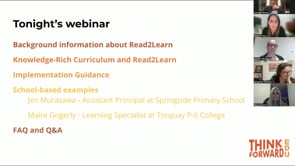
An introduction to the Read2Learn materials, this session provided a guided walkthrough of selected units, highlighting how the resources can be implemented effectively within your school context.
Project Leaders Melanie Hart and Samantha Charlton, together with experienced teachers from participating schools, responded to questions and provided practical guidance for educators seeking to embed Read2Learn within the curriculum and strengthen whole-school literacy practices.
Reading comprehension involves a range of language processes, from word decoding and vocabulary knowledge to inferencing and background knowledge. In this webinar, Nancy Hennessey’s "factory assembly line" metaphor is used to explore the key language foundations of reading, including word identification, morphology, syntax, figurative language, text comprehension and background knowledge.
