In Session 1, Kat will demonstrate how she has incorporated her knowledge of fluency research and inspiration from other maths fluency materials to develop sequenced strategy instruction and practice materials. Informed by the Instructional Hierarchy and following the Gradual Release of Responsibility framework weekly, Kat will model how she systematically builds fact fluency across fact sets. She will reflect on what she has learnt about implementation and how best to support teachers.
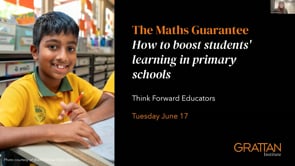
Grattan Institute is about to publish a guide on how to implement great maths teaching in primary schools. The practical, easy-to-follow guide complements Grattan Institute’s recent report, The Maths Guarantee: How to boost students’ learning in primary schools. In this presentation, Amy Haywood and Nick Parkinson will share Grattan’s summary of the evidence base and distil lessons from seven case study schools that have successfully translated the evidence into practice.
Screening assessments like DIBELS are increasingly used in English. But what about for maths? This session outlines the experience of Docklands Primary School in using Acadience Math, an example of universal screening assessment. Learn more about the assessment and how it can be used to support school improvement.
This session unpacks what is included in explicit Maths lessons that aligns with the VTLM 2.0. Look at evidence-based instructional models that we can draw upon to ensure that our practices align, as well as what this looks like when we are planning and teaching.
Key points included will be:
Review practices
Explicitly teaching new content
Guided and independent practice
Developing fluency
Assessing within lessons
This session is designed to help teachers enhance their classroom strategies by pairing bar models with abstract calculations, improving students' clarity in problem-solving. Learned how bar models can become the essential scaffold between concrete manipulatives and abstract concepts, solidifying core mathematical understanding for all learners.
This session explored the essential role of the Instructional Hierarchy in supporting effective learning. Sean unpacked its four stages and outlines how different teaching approaches align with each phase of learning. Using practical examples from primary classrooms, he demonstrated how the framework can inform lesson planning and delivery to support equitable outcomes for all students.
This session provided deeper insight into the Mathematics Lesson Plans developed by the Victorian Department of Education. Sacha discussed the Victorian Maths position statement and outlined the approach to the lessons and resources that have been released to support schools with teaching maths explicitly. The Victorian Lesson Plans are freely available to all educators and this session is open to educators across Australia.
In Session 2, Kat will model the Ninja Belts (timed testing) system, justify the adaptations made since the original development at Serpentine, and discuss the excitement levels for fluency from the school community. She will address common misconceptions about delivery, model practical setup and how to reduce the administration time. Kat will share the tracking and assessment systems used to monitor individual student progress and whole-school impact.

For mathematics instruction to reach its full potential in any school, the school must have a dual focus on both the 'what' and the 'how'. The 'what' is curriculum, the thoughtfully curated, sequenced, and planned content that is to be learnt by students. The 'how' is instruction, the way in which that curriculum is to be enacted in the classroom to maximise students' cognitive engagement and learning.
This online professional learning session will bring together teachers and school leaders from small schools to share how they structure and deliver mathematics in their unique contexts. We will be exploring class structures, typical lesson approaches, key influences on practice, and planning processes such as scope and sequence design or intervention supports.
Dr. Poncy discussed the benefits of declarative fact fluency when teaching mathematics. The fluent retrieval of basic facts provides distinct advantages over the reliance on multistep counting strategies as students work to access and link prior knowledge with new information to expand math skills.
