
By Phil Coloca and Jeanette Breen
For many years, teachers, schools and indeed systems, have struggled to conceptualise and articulate the complex task of teaching writing. As a result, writing has somewhat existed within a black box, becoming visible once per year within those year levels exposed to standardised testing. At a teacher-level, it surfaces more quietly: when they, while marking, recognise that a student required more explicit handwriting instruction, stronger spelling knowledge, or richer experiences to draw upon in their writing.
The implication is simple but significant: what we teach, when we teach and how explicitly we teach writing, matters. Whatever your current understanding of writing instruction, the accumulating evidence is building momentum and sharpening our collective clarity - providing the foundation for this relaunch of a space focused on Writing: instruction, curriculum and assessment.
The sticking point: persistent misconceptions
In stark contrast to reading, research into how best to structure and deliver writing instruction remains limited. As a result, schools and teachers respectively can feel trepidatious when approaching questions of how best to teach writing. This sense of unease has long transpired in a range of misconceptions, including:
Improvement in student writing is natural: that is, students not only absorb the capacity to write, but that improvement is contingent merely on the amount of time spent on task and in maximising writing opportunities;
That learning to write is a question of genre: While students absolutely need to develop an understanding of purpose, structure and relevant grammatical features, the issue here lies in the primacy with which genre has been elevated within the teaching process. This is at the expense of many of the foundational pieces required to ensure students are equipped to engage in extended composition of these texts;
That writing is a process-driven task: again, while planning, drafting and editing are necessary steps, similarly to the above, students without a clear sense of the components of writing will struggle to engage in the critical self-reflection required to engage in this process.
Teachers and schools engaged in these ways of thinking do so as a result of a range of factors. The aforementioned lack of research into the writing process (stacked considerably toward genre) being one, in addition to minimal guidance provided by both curricula and teacher training. As a result, teachers often find themselves perplexed with how best to support students with their writing, resulting in feedback that lacks precision and student work that lacks focus, and at the most basic level, sentence quality that does not meet its purpose.
Flipping perspectives: supporting students (and teachers) across a writing continuum.
Another, potentially more beneficial and instructive way to view writing may be to consider it broadly as existing across a developmental continuum, As David Didau contends, “The practice required to acquire any degree of skill is a continuous process. What this suggests is that the teaching of writing might best be served by a little and often approach” (Didau, 2024).
What we do in the classroom does not resemble the final performance. As such, writing should be considered as:
Cumulative rather than cyclical - knowledge and skills accrue over time and are not simply revisited in rotation.
Instructional rather than expressive-first - competence is built through deliberate teaching, not left to emerge incidentally.
A discipline with sequenced knowledge - where transcription, sentence construction, and text-level control develop systematically and interdependently.
The argument for a continuum approach becomes apparent when we flip the view from what the teacher teaches in each level, to what the student learns across their school journey from preschool to late secondary.
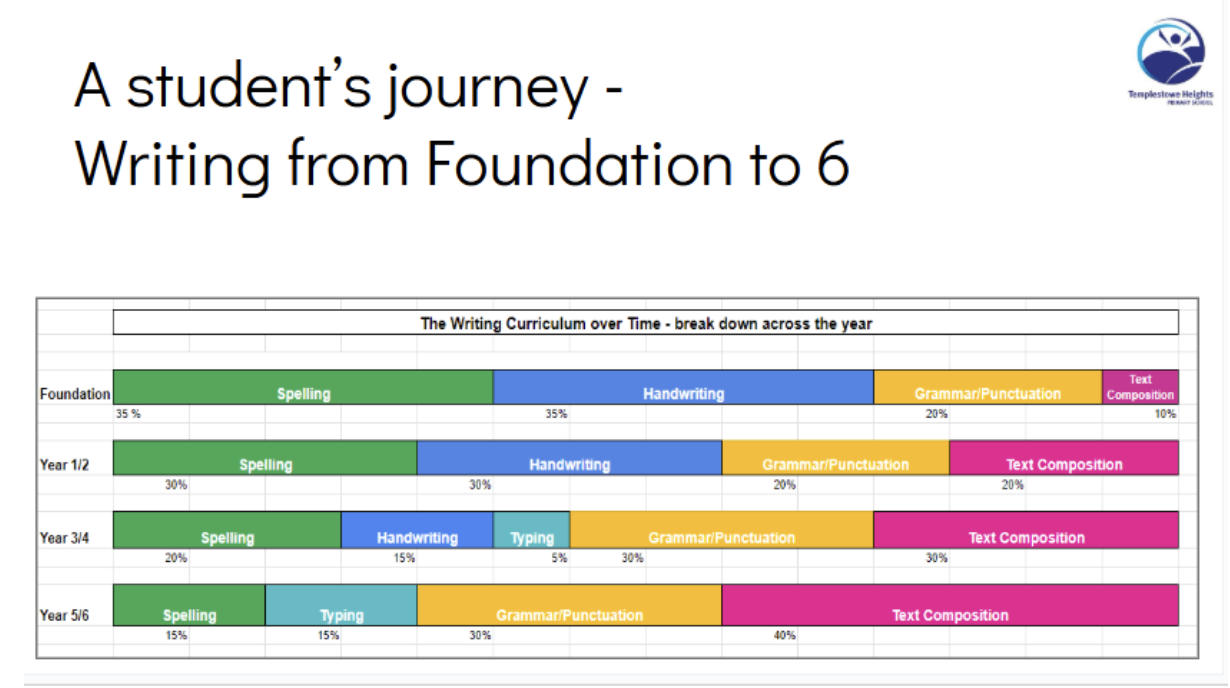
This graphic, adapted for an Australian context from the work of Andrew Percival (Stanley Road Primary School, Oldham), illustrates this clearly. When we frame our planning from the student’s perspective, we can better identify the instructional levers that move a learner from novice towards mastery.
Mastery in this case does not mean expert. Expert writers, whom we would classify as authors, provide the kinds of texts that endure over time. This is less than 1% of the population. Expertise is not a measurable school goal and we should not confuse it with mastery. Students are not being trained to become expert authors, but to master the writing demands of school in order to communicate ideas clearly and coherently. They will not, in real life, write about whatever they want. They will, in fact, be constrained by topics, essay questions, summary responses, creation of clear arguments. Therefore we need to ensure they have mastery over the skills that release cognition for these tasks. The counterpoint is critical: clarity precedes creativity. Students cannot meaningfully demonstrate their ‘voice’ without control over the medium.
Therefore if:
Writing quality is strongly constrained by sentence construction, syntax, and transcription skills.
Explicit instruction disproportionately benefits students without access to language-rich environments.
As such, schools need:
A shared progression to reduce inequity between classrooms and schools.
A map that provides every student with the opportunity to embed key skills across their school journey
What does our curriculum say—and why attend to it even when it’s vague?
The Victorian Curriculum is descriptive in the sense that it illustrates outcomes across a range of sub-strands encompassing language, literature and literacy. When considering the primary years for example, the VC 2.0 focuses on the accumulation of proficiency within these areas. Consider the sequence outlined below addressing handwriting attainment:
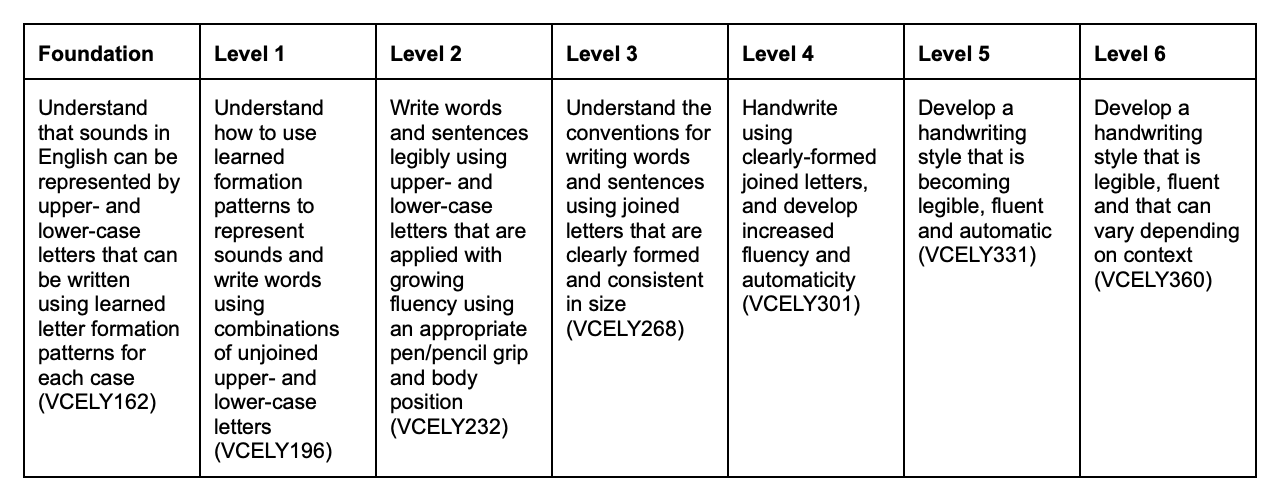
(Victorian Curriculum 2.0, VCAA)
For many teachers however, while the VC 2.0 expands on the ‘what’, in many respects, they are still searching for a greater sense of the ‘how’.
This is not a criticism necessarily, more so that it reflects the gap between the purpose of a document such as the VC 2.0, as opposed to an individual teacher's need for a level of prescription at the knowledge, skill, task and dosage level.
Consider here for example, that handwriting fluency is first referenced at Level 2. Yet, by Level 1, students are expected to
‘Recreate texts imaginatively’
‘Build on familiar texts using similar characters, repetitive patterns or vocabulary’
‘Create short, imaginative texts that show emerging use of appropriate text structure etc.’
Teachers versed in the principles of cognitive science will immediately recognise how demanding these tasks are in practice. Students expected to achieve at this level will require a level of transcription fluency that supports executive functioning tasks including ideation and the self-regulation required to monitor adherence to text structures.
Considering writing and its respective components within the framework of a developmental continuum therefore goes some way to demystifying this issue. Without it, schools risk significant variation across classrooms in both the quality and consistency of instruction, the perpetuation of gaps in student learning and, when desperation leads to the desire to find the quick fix, an over-reliance on commercial programs that may or may not be rooted in evidence.
Anchoring practice: emerging system-level support and resources
Research by Ronald T. Kellogg on the development of writing expertise, highlights just how long and complex this process is, estimating that it can take up to 20 years to develop an expert writer. Kellogg identifies distinct stages of development: beginners tend to write about themselves, intermediate writers share what they know largely for their own benefit, and only at the most advanced stage can writers reliably consider the needs, knowledge, and perspective of the reader.
The tension for schools is clear: we routinely ask young, novice writers to perform this final and most cognitively demanding goal. Kellogg’s work reminds us that writing is a long game, and that progress depends not on lowering expectations, but on deliberately creating the conditions, practice, and instructional coherence that allow students to move through these stages over time.
What follows, then, is a consideration of how schools can design for this at a whole-school level. Through more granular instructional choices that are supported by reliable objective assessment measures, schools can operationalise strong teaching practice.
As the shifts in education take hold across our system, two broad levers are evident in school decision making. These have their advantages but also opportunity costs:
Embed a Program:
Benefits: May provide structure and save teacher workload
Considerations: Risks replacing curriculum thinking and understanding of sequence; measurement of impact is unreliable.
Embed a Process:
Benefits: A shared understanding supports independence but can often assume skills already exist.
Considerations: All high-leverage tools are impacted by contextual considerations. It may be that mindset is changed, but for schools looking to provide structure and scaffolding particularly in the teacher knowledge gap, a deeper alignment may be required.
In either case, what becomes apparent is that regardless of approach, the complex task of teaching writing is one that requires significant intellectual preparation on the part of teachers with respect to:
Content knowledge (grammar, syntax etc)
Pedagogical knowledge (standards within a developmental continuum)
The strongest writing instruction emerges when intellectual preparation precedes process, and process serves content - not the reverse.
If this framing resonates with you, we invite you to join the TFE Writing Network. The network exists to strengthen the intellectual preparation of teachers, connect research to classroom practice, and build shared clarity about what high-quality writing instruction requires.
Continue the conversation in our upcoming webinar and register your interest here:
References
Berninger, V. W., Abbott, R. D., Abbott, S. P., Graham, S., & Richards, T. (2002). Writing and reading: Connections between language by hand and language by eye. Journal of Learning Disabilities, 35(1), 39–56. https://doi.org/10.1177/002221940203500104
(Foundational paper underpinning what is commonly referred to as the “Not So Simple View of Writing”)
Christodoulou, D. (n.d.). Blog posts. Retrieved from https://daisychristodoulou.com
Didau, D. (n.d.). Bringing the English curriculum to life: A field guide for making meaning in English.
Hochman, J. C., & Wexler, N. (2017). The writing revolution: A guide to advancing thinking through writing in all subjects and grades. Jossey-Bass.
Kellogg, R. T. (2008). Training writing skills: A cognitive developmental perspective. Journal of Writing Research, 1(1), 1–26.
Percival, A. (n.d.). Curriculum and instructional leadership work, Stanley Road Primary School, Oldham.
Victorian Curriculum and Assessment Authority. (n.d.). Victorian Curriculum. https://victoriancurriculum.vcaa.vic.edu.au
Victorian Curriculum and Assessment Authority. (n.d.). Victorian Teaching and Learning Model 2.0 (VTLM 2.0). https://www.vcaa.vic.edu.au
