
Introduction to MTSS Webinar by Stephanie Dehghani
By Zahra Harvey

Stephanie Dehghani is the Assistant Principal at Templestowe Heights Primary School, and her work there focuses on securing strong MTSS structures and processes at the school.
Stephanie began the webinar explaining why she has a passion in this area of education, borne out of both growing up, and working within disadvantaged communities, where disadvantage at home was often seen as the reason for poor learning outcomes. Stephanie challenged this assumption, emphasising that strong, evidence-informed, aligned instruction at school can mitigate disadvantage, with MTSS acting as the gateway to student success.
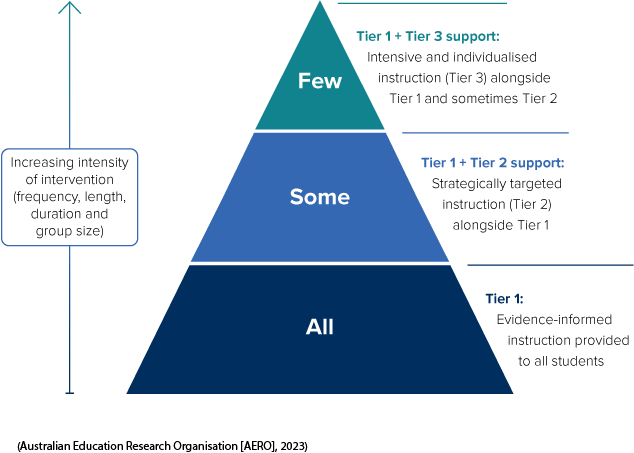
Tier 2 is not separate from Tier 1; students are not removed from core instruction but supported to access it more effectively.
The Solution
Steph discussed that the solution lies in solid Tier 1 instruction, drawn from an evidence base that includes Anita Archer’s Explicit Instruction, Rosenshine’s Principles of Instruction, AERO’s MTSS resources and many more. She provided a peek into the meticulous seven-year scope and sequence that makes up Templestowe Heights’ core instruction, including granular learning objectives that are taught and periodically reviewed by every teacher in every year level across the school. It is only upon this consistent, high-quality core instruction that they could begin to structure Tier 2 supports.
Steph detailed a successful Tier 2 pilot program Templestowe Heights implemented last year which focussed on phonics instruction for prep students. Students who screened at risk on DIBELS were provided with extra dosage (more time, practice and feedback) on sounds taught in Tier 1 instruction. This extra dosage was delivered by Rhys Coulson (principal), Stephanie Dehghani (assistant principal) and Jeanette Breen (learning specialist) four times a week for short 10-minute sessions, occurring during Eating Time so students didn’t miss any Tier 1 instruction. Progress monitoring occurred every 2 weeks and determined the focus for the next fortnight. All students involved demonstrated no risk by the end of prep, highlighting the success of the pilot. Steph acknowledged that the pilot was small, and scaling up the structures created challenges, but they were not insurmountable. The key to success relied on dosage, timetabling, and staffing.
The Problem
Steph asserted that one of the biggest challenges with establishing a strong MTSS, is when schools rush to focus on Tier 2 and 3 instruction before building a solid Tier 1 foundation. At Templestowe Heights, Tier 1 instruction has been the focus for over five years, and only now are they shifting their focus to Tier 2. The MTSS framework relies on ALL students experiencing evidence-informed core instruction. Without this, Tier 2 is inevitably overloaded, and the entire MTSS framework collapses.
The System
Steph used AERO’s MTSS graphic to explain the three tiers of instruction and highlighted the importance of alignment across the tiers. Tier 2 is not separate from Tier 1; students are not removed from core instruction but supported to access it more effectively. Tier 2 instruction is developed through data-informed decision making and delivered by skilled practitioners. Steph highlighted the need to build capacity of the staff delivering interventions, given they work with the most at risk students. Progress monitoring is also essential to evaluate the effectiveness of interventions and adjust support as needed.
Steph busted some of the most common misconceptions and myths about MTSS:
Tier 1 is for 80% of students → Tier 1 is for ALL students, 80% may require only Tier 1
MTSS means more intervention → MTSS begins with strong Tier 1 instruction, reducing the need for Tier 2 and 3
Tier 2 is a different program → Tier 2 should mirror Tier 1, providing increased exposure to core content
Intervention groups = MTSS → MTSS is a holistic framework with a foundation built on strong Tier 1 instruction before Tier 2 can be layered on top of it
Tier 2 replaces Tier 1 → Tier 2 should be in addition to Tier
When evaluating the effectiveness of MTSS at your school, Steph suggested thinking about the following elements that make up the ‘MTSS Ship’:
Strong Tier 1 core instruction
Universal screening
Data-based decision making
Tiered supports with increasing intensity
Progress monitoring
Clear entry and exit rules
Steph cautioned against withdrawing or omitting any of these elements, as without each and every one of them, MTSS is not being truly enacted.

The Network
Finally, Steph launched the TFE MTSS Network. She explained that after consultation with the community, schools don’t want programs but are looking for guidance on the systems and models that are working in other schools to enact MTSS in practice. The network, which is free to join, will form a space for educators to build knowledge, share successful practice, discuss implementation challenges and support one another. Join the network here.